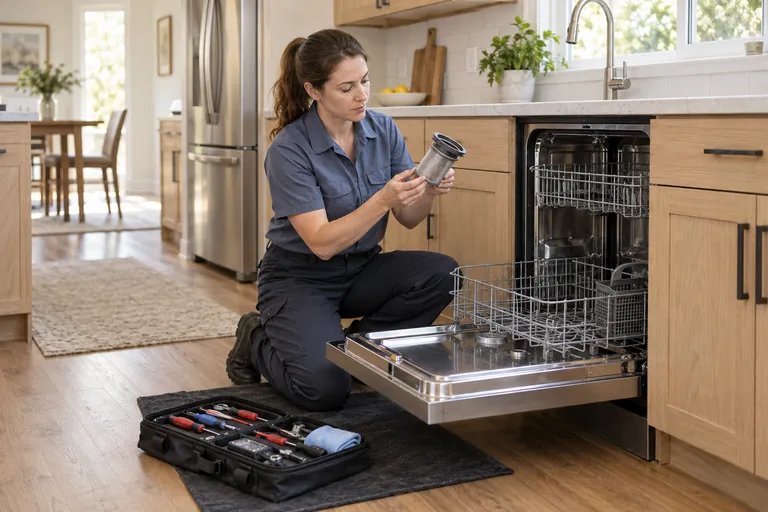
Hard water dishwasher problems in Calgary? Calgary's tap water is very hard — typically 150–200 mg/L of calcium carbonate — which is significantly harder than most Canadian cities. This affects every dishwasher in Calgary: white film on dishes, cloudy glassware, scale buildup inside the machine, and reduced appliance lifespan are all directly caused by mineral content in the water. This guide explains every solution and when to call for a repair. Book online or email calgary@appliancerepairneary.com.
Understanding Calgary's water hardness is essential for getting the most out of your dishwasher and protecting a $500–$2,000 appliance from premature failure. The solutions range from free (adjusting your rinse aid level) to a one-time investment (whole-home water softener) that pays for itself in appliance longevity and detergent savings.
Calgary Water Hardness — The Numbers
Calgary draws its water supply from the Bow and Elbow Rivers, which pick up calcium and magnesium as they flow through Alberta's limestone and bedrock geology. The City of Calgary Water Services reports water hardness in the range of 150–200 mg/L (equivalent to 9–12 grains per gallon).
For context:
- Soft water: Under 60 mg/L (e.g., Vancouver, Halifax)
- On-site appliance repair in the Calgary area is available by appointment. Share your service address when booking so we can confirm coverage and availability.
- Hard: 120–180 mg/L
- Very hard: 180+ mg/L
Calgary sits solidly in the "hard to very hard" range depending on the season and neighbourhood. This means the standard advice for dishwasher care — written assuming average North American water hardness — does not go far enough for Calgary households.
Symptoms of Hard Water in Your Calgary Dishwasher
- White chalky film on dishes, especially plastic containers
- Cloudy, foggy glassware (etching) that doesn't improve with rewashing
- White scale deposits on the interior walls and door seal
- Spray arm holes partially blocked with mineral deposits
- Detergent pod residue that doesn't fully dissolve
- Filter clogging faster than expected
Important Distinction: Not all cloudiness on glassware is from hard water scale — some is from etching, which is permanent glass damage caused by water that is too soft, too hot, or too much detergent. Test the glass: if a white film wipes off with vinegar-dampened cloth, it's scale (fixable). If the glass is permanently foggy even when wet, it's etching (irreversible).
Solution 1: Use Rinse Aid — Every Load
Rinse aid is the single most impactful change a Calgary homeowner can make for dishwasher performance. It works by reducing the surface tension of water so it sheets off dishes cleanly rather than forming droplets that leave mineral deposits when they dry. In Calgary's hard water, rinse aid is not optional — it is essential.
Set your dishwasher's rinse aid dispenser to the highest setting (typically 5 or 6 out of 6). The dispenser light should come on roughly every 2–3 weeks if you're using the correct amount. Finish Jet-Dry and Cascade Rinse Aid are both effective in Calgary's water chemistry.
Solution 2: Choose the Right Detergent
In Calgary's hard water, detergent pods perform better than powder or gel because they dissolve consistently and include pre-measured amounts of water-softening agents. The best-performing options in Alberta's water:
- Finish Quantum: Contains both rinse aid and water softeners, consistently rated best for hard water
- Cascade Platinum Plus: Good all-round hard water performance
- Somat Excellence: Excellent in very hard water, available at some Calgary grocery stores and online
Solution 3: Monthly Descaling Cycle
Calgary Hard Water Dishwasher Descaling — Monthly
- Remove all dishes from the dishwasher
- Place a dishwasher cleaner tablet (Finish, Affresh) or one cup of citric acid in the bottom of the tub
- Run the hottest, longest cycle available (usually "Heavy" or "Sanitize")
- Once the cycle completes, wipe down the door seal and edges with a cloth dampened in white vinegar
- Clean the filter under running hot water with a soft brush
Solution 4: Bosch Dishwashers and Built-In Water Softeners
Bosch dishwashers sold in Canada have a built-in water softening system that uses dishwasher salt to regenerate an ion-exchange resin. This system is specifically designed for markets with hard water — and Calgary is an ideal candidate. If you have a Bosch dishwasher, check if the salt reservoir is active (Settings menu → Water Hardness) and fill it with dishwasher salt, not table salt.
In Calgary, set the Bosch water hardness level to setting 5 or 6 (out of 7) for optimal softening. The salt reservoir typically needs refilling every 4–6 weeks under daily use.
Solution 5: Whole-Home Water Softener
The most comprehensive solution for Calgary hard water is a whole-home water softener. These ion-exchange systems replace calcium and magnesium ions with sodium, reducing water hardness to 0–50 mg/L throughout the house. Benefits extend beyond the dishwasher to include longer water heater life, reduced scale on shower fixtures, softer laundry, and better soap lathering.
Installation cost in Calgary: $1,200–$2,500 for equipment and installation. The payback period in appliance repair savings, water heater efficiency, and detergent cost reduction is typically 5–8 years for an average Calgary family.
When Hard Water Causes Repair-Level Damage
If descaling and maintenance improvements haven't resolved performance issues — or if your dishwasher is 5+ years old with no maintenance history — the limescale damage may have progressed to the point where repair is needed:
- Heating element burned out from scale insulation
- Spray arm bearings seized from mineral buildup
- Pump impeller damaged by hardened scale fragments
- Control panel errors from scale-related electrical faults
Dishwasher damaged by Calgary hard water? Book a repair online or email calgary@appliancerepairneary.com. We service all Calgary communities including Beltline, Mission, Hillhurst, Kensington, Parkdale, and all SW, NW, NE, SE quadrants.