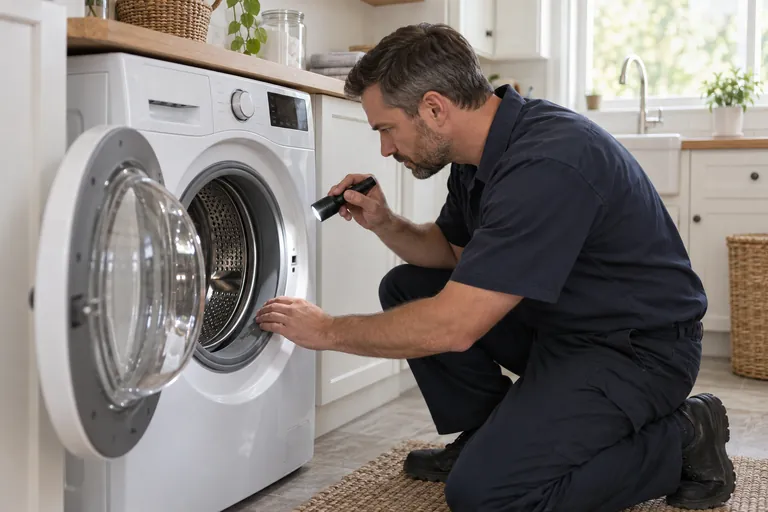
On-site service is available by appointment; submit a booking request so the team can confirm current availability.
How Freezers Are Supposed to Work
Most household freezers—whether standalone chest or upright units or the freezer section of a fridge-freezer combo—work on the same refrigeration principle: a compressor pumps refrigerant through an evaporator coil, which absorbs heat from the freezer compartment. A fan circulates air across that coil. An automatic defrost system periodically melts frost accumulation off the coil so airflow stays unobstructed.
Any fault in this chain—fan, defrost system, compressor, or refrigerant—will cause the freezer to gradually or suddenly warm up.
The Most Common Causes
1. Failed Defrost System (Defrost Heater or Thermostat)
Automatic defrost is a cycle that runs every 8–12 hours. An electric heater melts frost off the evaporator coil; a defrost thermostat monitors temperature to prevent overheating; a defrost timer or control board initiates and ends the cycle.
When the defrost heater burns out or the defrost thermostat fails in the closed position, frost accumulates session by session until the entire evaporator coil is encased in ice. At that point, no air can circulate and the freezer gradually climbs to room temperature over several days. This is one of the most common freezer faults we see in Toronto—and it’s completely fixable.
Diagnosis involves manually defrosting the unit (24 hours unplugged), then testing heater resistance and thermostat continuity. Repair cost: $120–$200 for a defrost heater replacement, $90–$150 for just the thermostat.
2. Evaporator Fan Motor Failure
The evaporator fan circulates cold air from the coil throughout the freezer (and in fridge-freezer combos, into the fresh food section as well). When this motor fails, you get a freezer that’s still making cold air at the coil but not distributing it—so the center of the freezer may stay marginally cold while the door shelves and corners warm up.
You can test this: with the freezer section empty and the door open, hold the door switch closed (this tricks the fan into running with the door open) and listen for the fan. Silence from the freezer back panel when the compressor is running means fan failure. Cost to repair: $110–$190.
3. Door Seal Failure
A leaking door seal allows warm, humid air to continuously enter the freezer. The extra moisture creates heavy frost accumulation, and the compressor runs continuously trying to maintain temperature—eventually failing from overwork. You’ll notice the freezer running almost constantly, heavier-than-normal frost on one side, and possibly condensation on the door exterior.
Check the door gasket by closing the door on a piece of paper: if you can pull the paper out easily, the seal has lost its grip. Gasket replacement: $80–$150 depending on the model.
4. Refrigerant Leak or Low Charge
If the sealed refrigeration system has a slow leak, refrigerant charge drops gradually and the system loses cooling capacity. Unlike a failed fan or defrost heater, a refrigerant issue means the compressor runs constantly but the freezer never reaches temperature. You may also hear the compressor running unusually loudly or feel the refrigerant lines are warmer than normal near the compressor.
Refrigerant repair requires a TSSA-licensed technician: leak detection, repair of the leak point, and recharge. Cost: $200–$400 depending on the extent of the leak and refrigerant type.
5. Compressor Failure
If the compressor itself has failed—seized motor, failed start relay, or burned windings—the freezer will warm up completely and the compressor will be either silent or clicking rapidly as the protection circuit trips. This is the most expensive repair ($350–$600+) and is generally only recommended on units under 8–10 years old.
Food safety note: A freezer at -15°C or above for more than 2 hours should be treated as compromised. Move food to another freezer, a cooler with ice, or a neighbour’s freezer while awaiting repair. Do not refreeze thawed meat without cooking it first.
Self-Check Before Calling
- Is the temperature above -15°C? Move food now.
- Is the compressor running (can you hear or feel vibration)?
- Is the evaporator fan running (listen inside freezer with door held closed)?
- Is there unusual frost buildup, especially on the back wall?
- Is the door seal tight? (Paper test)