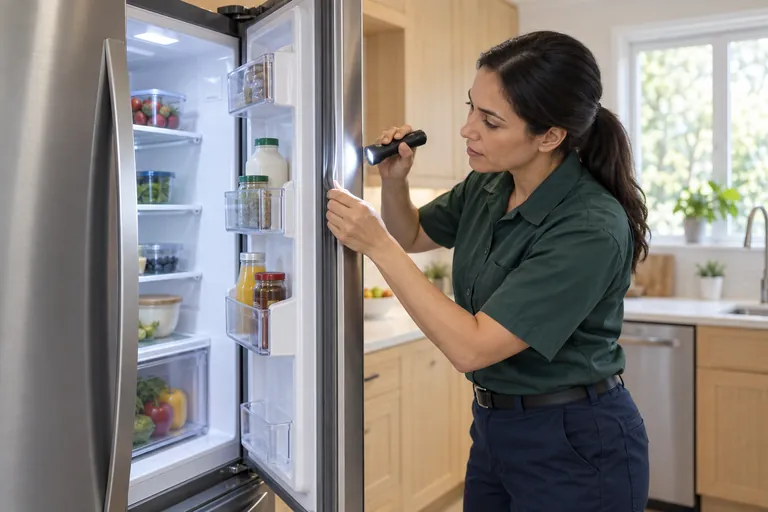
On-site service is available by appointment; submit a booking request so the team can confirm current availability.
Normal Fridge Sounds (Don’t Worry)
Before assuming something is wrong, know what’s normal. A healthy refrigerator makes these sounds regularly:
- Soft hum or buzz: The compressor running. Normal, especially after the door is opened.
- Clicking: The thermostat or relay switching the compressor on and off. Happens every 15–45 minutes.
- Dripping or gurgling: Refrigerant or water flowing. Common during and after defrost cycles.
- Crackling or popping: Plastic interior panels expanding and contracting with temperature changes.
These sounds should be relatively quiet and consistent. If a sound has changed in volume or character, or if it’s new, read on.
Diagnosing Fridge Noise by Sound Type
Loud Rattling or Vibrating
Rattling is often mechanical—something is loose. The most common culprits: the drain pan underneath the fridge (it sits on mounts that can loosen over time), the condenser fan blade striking a wire or piece of debris, or the compressor mounting bolts vibrating. Pull the fridge away from the wall and check the back panel. On French-door and bottom-freezer models, the drain pan is at the front bottom.
Also check: is anything resting on top of the fridge? A bottle, appliance, or loose item on top amplifies vibration dramatically.
Loud Buzzing or Humming
A louder-than-normal buzz that runs continuously or gets louder when you open the freezer points to the condenser fan motor or evaporator fan motor. These small motors circulate air across the coils; when their bearings wear out, they produce a pronounced buzzing or humming sound.
The condenser fan sits at the back bottom of the fridge, near the compressor. The evaporator fan is inside the freezer section, behind a back panel. You can often tell which one it is by where the noise seems loudest: back of the fridge = condenser fan; inside the freezer = evaporator fan.
Fan motor replacement costs $110–$210 depending on location and brand—a straightforward repair that our technicians complete in under an hour.
Clicking That Repeats Every Few Minutes
Rapid clicking that repeats on a cycle (typically: click-click-silence, then again a few minutes later) usually means the compressor start relay has failed. The relay is a small component that gives the compressor motor its initial electrical kick. When it fails, the compressor tries to start, clicks, fails, and the protection circuit shuts it down to try again later.
You can test this yourself: unplug the fridge, access the compressor (usually at the back bottom behind a panel), remove the small relay from the side of the compressor, and shake it. If it rattles like a maraca, it’s failed. A new relay costs $15–$25 and takes about 10 minutes to replace—but if the compressor itself has failed, that’s a more expensive conversation.
High-Pitched Squealing
A squealing or chirping sound from the freezer section is almost always a worn evaporator fan motor bearing. This is especially common in Samsung and LG French-door refrigerators, which are known for this issue. The evaporator fan runs every time the compressor is running; worn bearings squeal intermittently and get worse over time.
On Samsung models, this is a well-documented issue with units made between 2014–2020. LG has issued a service bulletin for similar fan noise on some of its French-door models. Replacement is $110–$190 including parts and labour.
Loud Knocking or Banging
A banging sound, especially during compressor startup or shutdown, can indicate the compressor itself is starting to fail—its internal pistons or mounting springs may be worn. It can also indicate ice buildup around the evaporator fan, causing the fan blade to hit ice periodically. Defrosting the freezer section completely (24 hours unplugged) will tell you if ice is the cause. If the banging continues after defrost, have the compressor inspected.
On-site service is available by appointment; submit a booking request so the team can confirm current availability.
Quick Noise Diagnosis Checklist
- Is the noise from the back bottom (compressor / condenser fan)?
- Is the noise from inside the freezer (evaporator fan)?
- Does it click repeatedly without the compressor staying on?
- Is it a rattle you can stop by pressing on certain panels?
- Is food temperature normal, or is the fridge warming up?
Repair or Replace?
Fan motors and start relays are inexpensive repairs worth doing on fridges of any age. Compressor replacement ($350–$600) is worth considering if the unit is under 8 years old and otherwise in good condition—a newer compressor can add 6–10 more years of life. On a unit over 12 years old with a failed compressor, replacement is usually the better value.