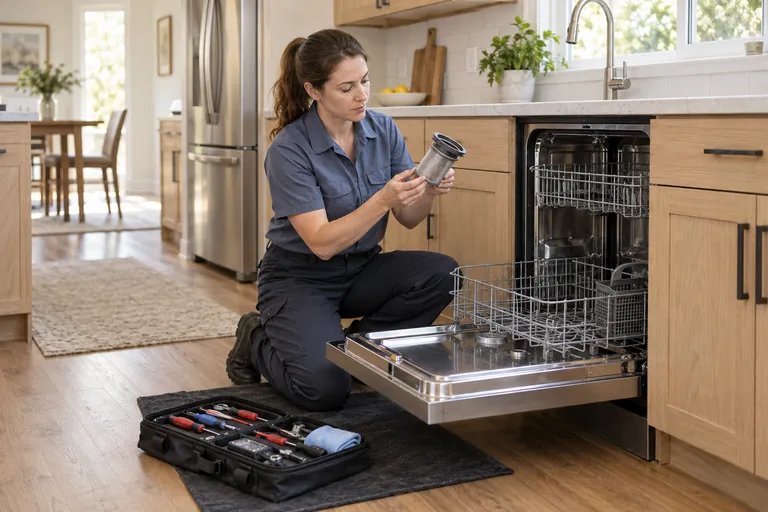
On-site service is available by appointment; submit a booking request so the team can confirm current availability.
Where Is the Water Coming From?
Before calling for service, try to identify where the leak originates—it will help the technician bring the right parts. Run a short cycle and watch: does water appear at the door’s edge, pool directly under the unit, or seep from beneath the front kick plate? Each location points to a different component.
Top Causes of Dishwasher Leaks
1. Worn or Damaged Door Gasket
The door gasket (also called the door seal or tub gasket) is a rubber or silicone strip that runs around the perimeter of the dishwasher tub opening. It creates a watertight seal when the door closes. Over time—typically 5–10 years—this gasket dries out, cracks, or becomes deformed, especially along the bottom corners where it bends most sharply.
Signs: water drips from the door bottom or corners during the wash cycle. The gasket may look cracked, flat, or feel brittle to the touch. Replacement costs $90–$150 including labour and takes about 30 minutes. On most brands (Bosch, KitchenAid, LG, Samsung), the gasket presses into a channel without special tools.
2. Pump Seal or Motor Shaft Seal Failure
The wash pump and drain pump both have mechanical shaft seals where the motor connects to the impeller. These seals wear over time, especially in dishwashers that run hard water cycles frequently—Toronto’s water hardness accelerates wear. When a pump seal fails, water drips directly below the unit and may only appear during the pump’s high-pressure phases.
This repair requires pulling the dishwasher out from the cabinet, disconnecting water and electrical, and accessing the pump from underneath. Cost: $140–$240 depending on whether the pump body itself also needs replacing.
3. Faulty Water Inlet Valve
The inlet valve opens to let water into the tub at the start of each cycle and closes when the tub reaches the correct fill level. A valve that’s starting to fail may not close completely, allowing a slow trickle of water into the tub even when the dishwasher is off—which eventually overflows through the door seal. A cracked valve body leaks directly at the connection point under the unit.
You can sometimes hear a hissing sound from the dishwasher area between cycles when the inlet valve is failing. Replacement costs $110–$180 and includes shutting off the water supply, swapping the valve, and testing for leaks.
4. Damaged Spray Arm or Blocked Jets
If a spray arm cracks or a jet becomes blocked with mineral deposits, water can be directed toward the door seal at high pressure instead of the dishes. This creates a leak that appears to come from the door even though the gasket is fine. Cleaning or replacing the spray arms ($40–$80) resolves this type of leak.
5. Overfill from a Failed Float Switch
The float switch monitors water level inside the tub. When it sticks in the down position (usually from debris buildup), the inlet valve stays open too long and the tub overfills—water spills over the door seal or pushes past the pump seal. Cleaning the float assembly fixes the problem in many cases; replacing the switch costs $60–$100.
Important: If you see water under the dishwasher after a cycle ends, turn off the water supply valve under the sink before the next cycle. This prevents further flooding while you wait for service.
Bosch vs. Samsung vs. LG: Leak Patterns
Bosch dishwashers (very common in Toronto condos and renovated kitchens) have an Aquastop safety system—a double-walled inlet hose with a float valve that cuts water flow if a leak is detected in the base tray. If your Bosch stops mid-cycle and won’t restart, the Aquastop may have tripped, meaning water is already in the base. This isn’t a repair—it’s a safety feature that signals a leak elsewhere.
Samsung and LG dishwashers commonly develop door gasket issues around the 4–6 year mark, often related to the heavier door design. LG also has a known issue with the drain pump housing cracking on units manufactured before 2021.
Before the Technician Arrives
- Stop using the dishwasher to prevent further water damage
- Note where exactly the water appears (door, front, under unit)
- Turn off the water supply valve under the sink if leaking is severe
- Take a photo of the leak location and any visible damage
- Check if your dishwasher is still under manufacturer warranty
Repair Cost vs. Replacement
Gasket and inlet valve repairs are almost always worth doing—even on older units. A $130 repair vs. $700–$1,800 for a new dishwasher is an easy decision. We recommend repair when the unit is under 10 years old and the repair cost is under 50% of replacement value. We’ll give you that assessment on the spot.