On-site service is available by appointment; submit a booking request so the team can confirm current availability.
This local guide breaks down every major cause of poor dishwasher cleaning, tells you what you can fix yourself, and tells you when to call a tech near you in Toronto.
1. Clogged Spray Arms
The spray arms are the spinning components at the bottom (and often middle and top) of your dishwasher that spray water onto your dishes. Each arm has small nozzle holes that can become clogged with mineral deposits, food particles, and detergent residue over time.
When these holes are blocked, water pressure drops and coverage becomes uneven — some dishes get blasted while others barely get wet. This is especially common in GTA homes because Toronto's water has moderate hardness, meaning calcium and magnesium deposits build up faster than in softer-water regions.
How to Clean Your Spray Arms
- Remove the lower rack and unscrew or clip off the lower spray arm (most twist off counterclockwise)
- Hold the arm under running water and use a toothpick or thin wire to clear any blocked holes
- Soak in a bowl of white vinegar for 20–30 minutes if deposits are heavy
- Rinse, reinstall, and run a test cycle
- Repeat for the upper spray arm if accessible
2. A Dirty or Blocked Filter
Modern dishwashers use a self-cleaning filter system that traps food particles to prevent them from recirculating onto clean dishes. When this filter is not cleaned regularly, it becomes blocked — reducing water circulation throughout the entire wash cycle and leaving visible food residue on everything in the load.
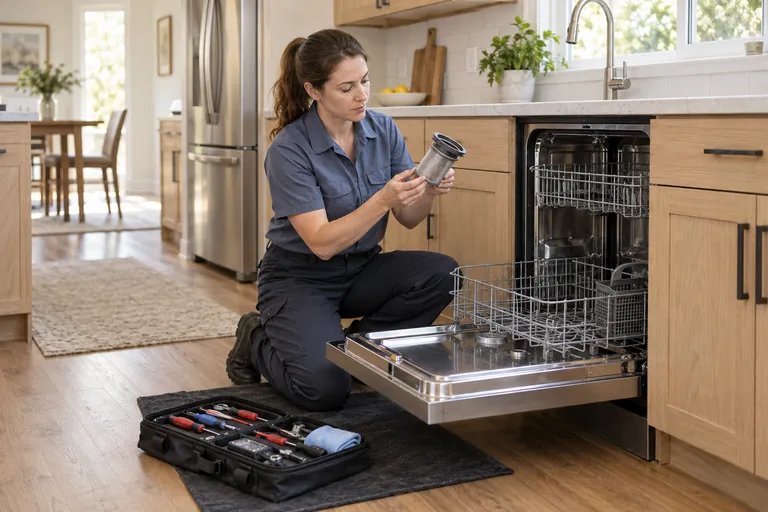
The filter is located at the bottom of the dishwasher tub, under the lower spray arm. On most brands (Bosch, Samsung, LG, Miele), it is a cylindrical mesh filter you can twist and lift out. Rinse it under hot water, scrub gently with a soft brush, and reinstall.
Toronto GTA Tip: In areas with moderately hard water like most of the GTA, running a monthly dishwasher cleaning cycle with a commercial descaler (like Finish Dishwasher Cleaner) removes limescale from the filter, pump, and spray arms simultaneously. This is the single best maintenance habit you can develop.
3. Water Temperature Is Too Low
Dishwashers clean effectively when the water entering the machine is at least 49°C (120°F), and preferably 60°C for heavy soil cycles. If your home's hot water heater is set too low, the dishwasher never reaches cleaning temperature — bacteria are not killed and grease does not dissolve properly.
Test your water temperature by running the kitchen hot tap for 60 seconds (to purge cool water from the pipes) and then filling a glass. Use a kitchen thermometer to check. If it is below 49°C, raise your water heater setpoint. This costs nothing and makes a significant difference.
Note: some older dishwashers have a faulty internal heating element that is supposed to boost water temperature during the cycle. If your water heater is correctly set but the dishwasher still cleans poorly, the heating element may need replacement — this requires a technician.
4. Wrong Detergent or Incorrect Dosage
Detergent matters more than most people realize. Powder detergent that has been sitting in a humid under-sink cabinet can absorb moisture and clump — degrading its cleaning effectiveness significantly. Pods are more reliable for consistent dosing but can struggle in very hard water without supplementary rinse aid.
For GTA homes with hard water: use a dishwasher detergent that includes a built-in rinse agent, and add separate rinse aid to the dispenser. The combination tackles hard water deposits on both the dishes and the dishwasher interior.
5. Hard Water Scale on Dishwasher Interior
Over time, hard water leaves a white chalky film on the interior walls, door seal, and spray arms of your dishwasher. This scale does not just look bad — it acts as an insulating layer that reduces heat transfer and can partially block the spray arm pivot points.
A monthly descaling cycle with citric acid or a commercial dishwasher cleaner dissolves this buildup and restores performance. Run the cleaner on a hot, empty cycle without dishes.
When to Call a Dishwasher Repair Tech Near You
After cleaning the filter, clearing the spray arms, and verifying water temperature, most dishwashers show immediate improvement. But some problems require a professional near you in the GTA:
- The dishwasher is not filling with water at all (water inlet valve failure)
- The wash pump motor is making grinding or buzzing sounds
- The spray arms are physically cracked or broken and need replacement
- Error codes are appearing on the display
- Water is pooling at the bottom after cycles (drain pump issue)
On-site service is available by appointment; submit a booking request so the team can confirm current availability.
On-site service is available by appointment; submit a booking request so the team can confirm current availability.