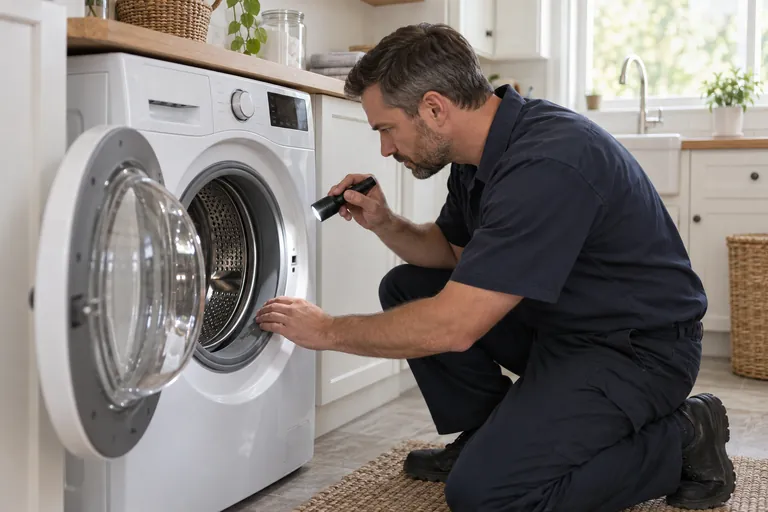
On-site service is available by appointment; submit a booking request so the team can confirm current availability.
Why Spin Matters More Than You Think
The spin cycle isn’t just about convenience—it removes the bulk of water from laundry before drying. A proper high-speed spin can remove 60–70% of water from a load. Without it, your dryer has to work 3–4 times as hard, dramatically increasing energy costs and drying time. It also stresses the dryer’s heating element and drum bearing. A faulty washer spin eventually leads to a faulty dryer too.
Top Causes of Washer Not Spinning
1. Lid Switch or Door Latch Failure
This is the number one cause of spin failure on top-load washers and a very common cause on front-loaders. The lid switch is a safety device—the washer will not spin if it doesn’t detect a properly closed lid. Over time, the plastic actuator tab on the lid that presses the switch can break off, or the switch contacts inside can fail.
Test: on a top-loader, press the lid switch manually with your finger while running a spin cycle. If the drum engages, the switch or the actuator tab has failed. Replacement cost: $90–$140 including a service call.
2. Worn Motor Coupling (Direct-Drive Top-Loaders)
Many Whirlpool, Maytag, and Kenmore top-load washers use a direct-drive motor connected to the transmission via a plastic motor coupling. This coupling is intentionally designed to break if the motor or transmission seizes—it’s a sacrificial part. When it breaks (usually from repeated overloaded cycles), the motor runs but the drum doesn’t spin.
Signs: you hear the motor running but the drum doesn’t move. The coupling is a two- or three-piece plastic part that costs $8–$15; the labour to access and replace it is $100–$160 total.
3. Broken Drive Belt
Belt-drive washers (common in older GE, Frigidaire, and some Samsung models) use a rubber drive belt to connect the motor to the drum. The belt wears, stretches, and eventually cracks or breaks entirely. A broken belt means the drum spins freely by hand but won’t engage during the cycle.
You can often diagnose this yourself: open the door and try to spin the drum by hand. If it spins very freely with almost no resistance, the belt is likely broken. If it’s stiff or won’t turn, the problem is elsewhere. Belt replacement: $80–$130 all-in.
4. Motor Control Board Failure
Electronic front-load and high-efficiency top-load washers control motor speed through a motor control board (MCB). When this board fails—from a power surge, moisture ingress, or component aging—the motor gets incorrect speed commands or none at all. Symptoms: the washer seems to start the spin cycle but never accelerates, or it makes a brief attempt then gives up.
Error codes associated with MCB failure: Samsung UE or Ub (unbalance or motor issue), LG UE or tE (motor issue), Whirlpool F5E3 or F7E1. MCB replacement is the most expensive spin repair: $180–$320 depending on the brand and model.
5. Shock Absorbers or Suspension Rods Worn
On front-load washers, four shock absorbers dampen drum vibration during high-speed spin. When they wear out (typically after 7–10 years of use), the drum vibrates violently, the machine walks across the floor, and the control system detects the imbalance and cuts spin speed or stops entirely. You’ll hear loud banging and thumping during any spin attempt.
Shock absorber replacement is $140–$220 (all four should be replaced at once, not just the failed ones).
Quick test: Try a spin-only cycle with nothing in the drum. If the machine spins an empty drum fine but not with laundry, the issue may be overloading or a failing suspension—not a motor or electrical fault.
What to Expect on a Service Call
Our technicians carry lid switches, motor couplings, and drive belts for the most common brands on the van. We diagnose the root cause before quoting any repair, and we’ll tell you if multiple components have failed. On most spin repairs in Toronto, we’re done within 60–90 minutes.
Before You Call: Things to Try
- Redistribute laundry evenly in the drum and retry spin
- Check that the lid or door is fully closing and latching
- Make sure the washer is level (use a spirit level, adjust feet)
- Note any error codes on the display
- Try a spin-only cycle with an empty drum